Halal, Muslim-Friendly, or Pork-Free? How to Choose Korean Restaurants Before You Order
Last reviewed: August 28, 2026.
Planning a Korea trip and wondering whether a restaurant is genuinely halal, Muslim-friendly, or simply pork-free? I understand why the labels can feel confusing. A menu photo may look safe, but the important details are often in the sauce, cooking method, shared kitchen, or alcohol policy.
The good news is that you do not have to guess. The Korea Tourism Organization (KTO) uses four categories for Muslim-friendly restaurants: Halal Certified, Self-certified, Muslim Friendly, and Pork free. They are useful categories, but they are not interchangeable. This guide explains how to read them and what I would ask before placing an order.
Why the restaurant label matters more than the menu photo
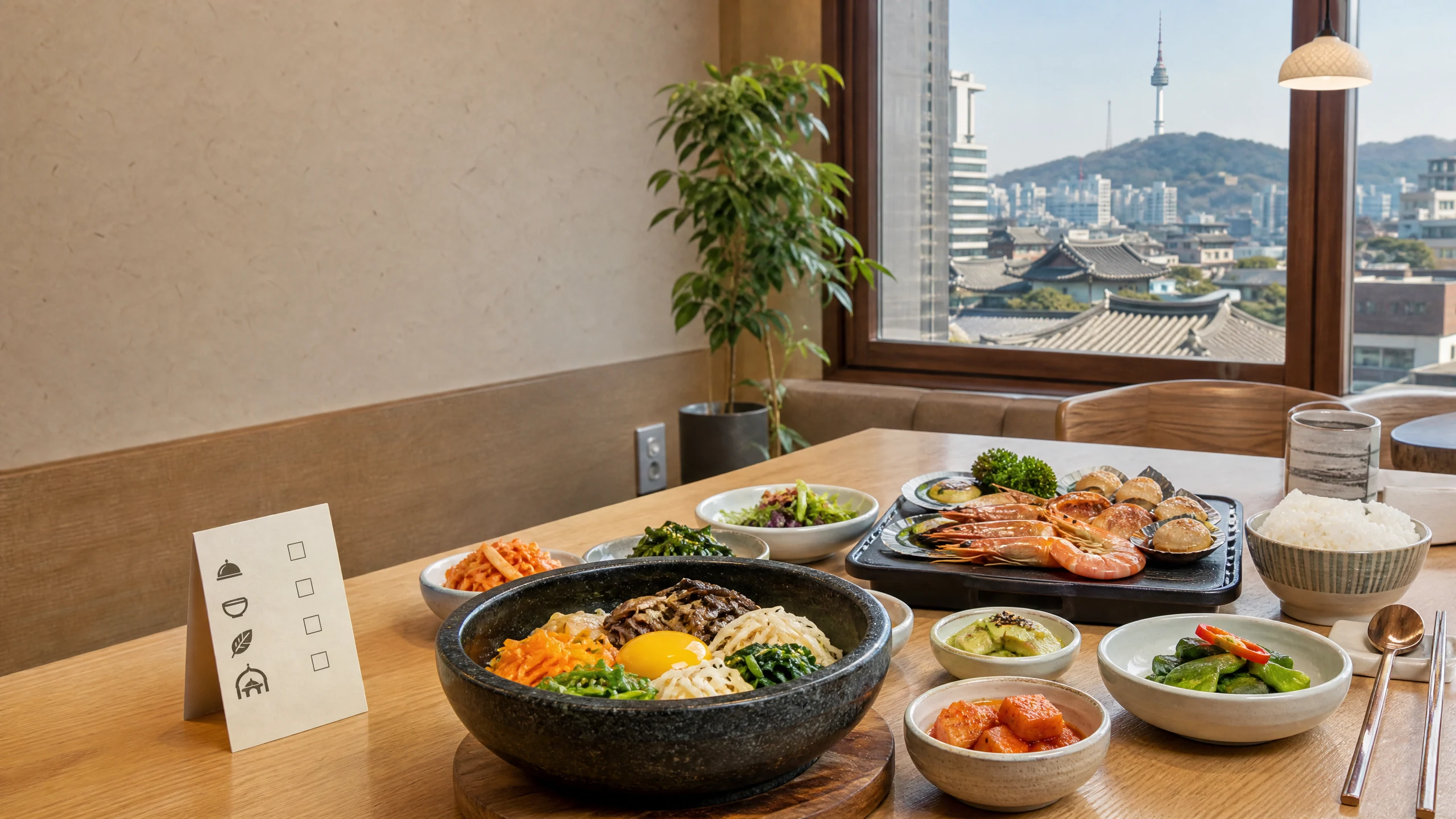
A Korean dish can contain more than its main ingredient. Sauces, marinades, broths, and side dishes may include ingredients that do not appear in a photograph. A restaurant may also sell alcohol or prepare different foods in the same kitchen.
That does not mean Korean food is impossible for Muslim travelers. It means the safest approach is to identify the restaurant category first, then check the specific dish against your own dietary requirements. A KTO category is a helpful starting point, not a substitute for asking about the current menu.
Korea’s four Muslim-friendly restaurant categories
KTO groups selected restaurants into four categories. The practical differences matter when you decide how much verification you need.1
| KTO category | What it means | What you should still check |
|---|---|---|
| Halal Certified | Certified by an accredited halal certification agency, such as the Korea Muslim Federation. | Confirm that the certificate and current menu still match, especially after a change of location or ownership. |
| Self-certified | The Muslim restaurant owners themselves certify that the food is halal. | Ask which dishes are included and whether the kitchen also handles non-halal ingredients. |
| Muslim Friendly | Some halal dishes are available. Alcohol may also be sold. | Ask for the halal menu, cooking method, sauces, and alcohol policy before ordering. |
| Pork free | Pork is not used, but the restaurant does not offer a halal menu. Alcohol may be sold. | Do not automatically treat “pork free” as halal. Check meat, alcohol, stock, sauces, and shared preparation. |
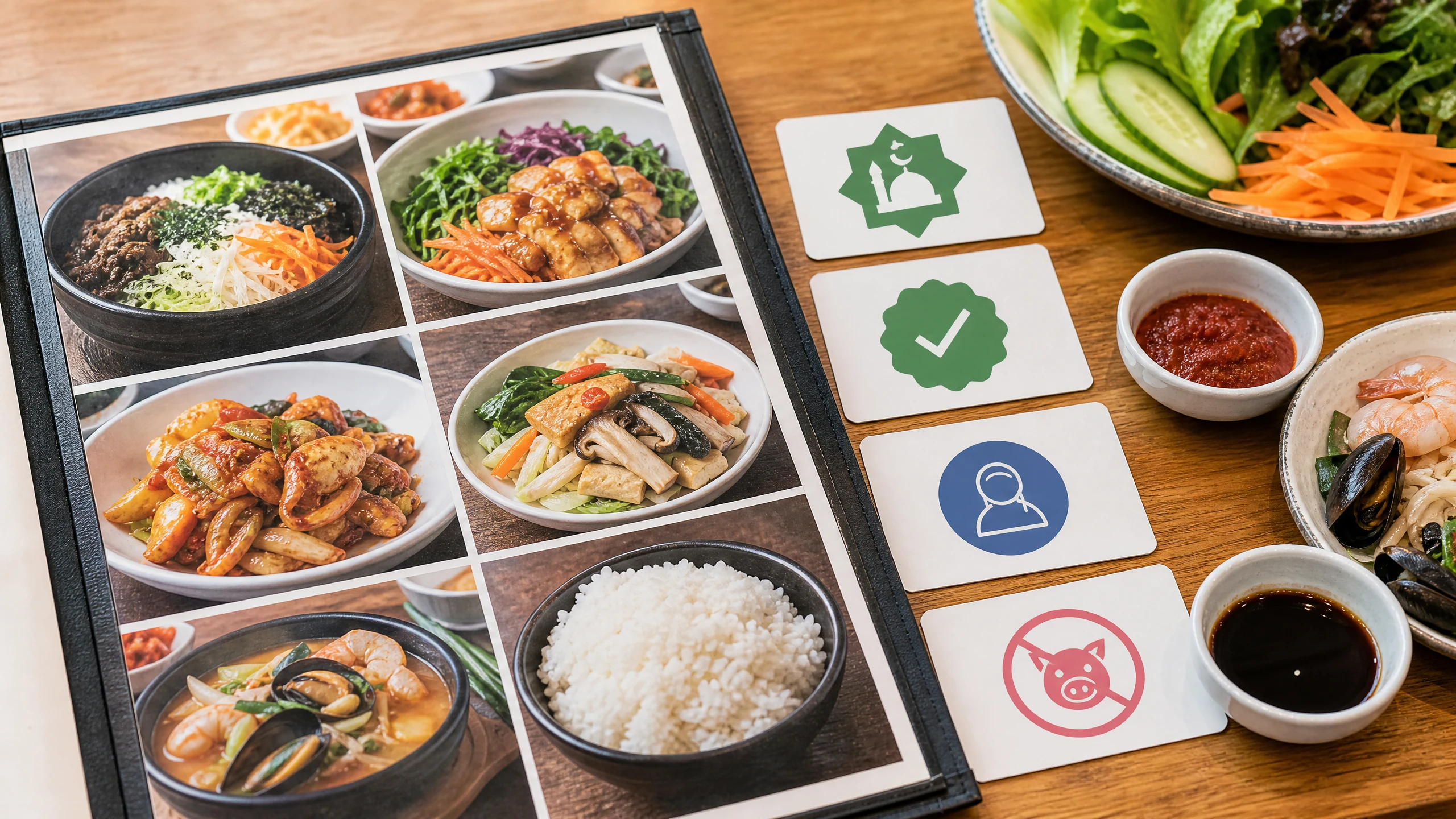
KTO also uses pictograms for details such as a Muslim owner or chef, halal-menu availability, reservation requirements, alcohol-free service, and pork-free service. These icons can help narrow options, but the restaurant’s current information remains the final practical check.1
Halal Certified vs Self-certified: what is the difference?
The short version is that Halal Certified refers to certification by an accredited halal certification agency, while Self-certified refers to a halal declaration made by Muslim restaurant owners themselves. Both labels can be useful, but they represent different verification routes.
If a restaurant is important to your itinerary, save its current contact details before you travel. I would ask whether the certification or self-certification still applies to the dish I plan to eat. That extra check is especially helpful when traveling with family or when you follow strict rules around meat, alcohol, or shared cooking equipment.
What “Muslim Friendly” and “Pork free” do not automatically mean
This is the point where it is easy to overgeneralize. Muslim Friendly does not necessarily mean every dish is halal, because KTO describes the category as offering some halal dishes and notes that alcohol may be sold. Pork free does not necessarily mean halal, because KTO describes it as a restaurant without pork that may not offer a halal menu and may sell alcohol.1
Hotel restaurants and buffets can require extra care. KTO specifically warns that hotel restaurants or buffets categorized as Muslim-friendly may serve dishes containing pork. If you are unsure, ask staff to identify the suitable dishes rather than relying on the category alone.
Five questions to ask before ordering Korean food
You can keep the conversation simple. Here are the questions I would prepare in advance:
- Is there a halal menu? Ask whether the restaurant has a menu specifically identified as halal.
- Does this dish contain pork or pork-based ingredients? Check the meat, broth, sauce, and side dishes.
- Does this dish contain alcohol or cooking wine? This matters for marinades, sauces, and soup bases.
- Is the meat halal-certified, or is the dish vegetarian or seafood-based? Do not assume that a meat-free-looking sauce is suitable without checking.
- Is reservation required for the halal menu? KTO’s pictograms identify restaurants where advance reservation may be required.
If a staff member is unsure, it is reasonable to choose a different dish or restaurant. A short, respectful question is better than an uncertain order.
Useful Korean questions for a restaurant
| English | Korean | Pronunciation guide |
|---|---|---|
| Is there a halal menu? | 할랄 메뉴가 있나요? | halal menyuga innayo? |
| Does this contain pork? | 돼지고기가 들어가나요? | dwaejigogiga deureoganayo? |
| Does this contain alcohol? | 술이나 알코올이 들어가나요? | sur-ina alko-ori deureoganayo? |
| Is the meat halal-certified? | 고기가 할랄 인증인가요? | gogiga halal injeung-ingayo? |
| I cannot eat pork. | 저는 돼지고기를 먹지 않아요. | jeoneun dwaejigogi-reul meokji anayo. |
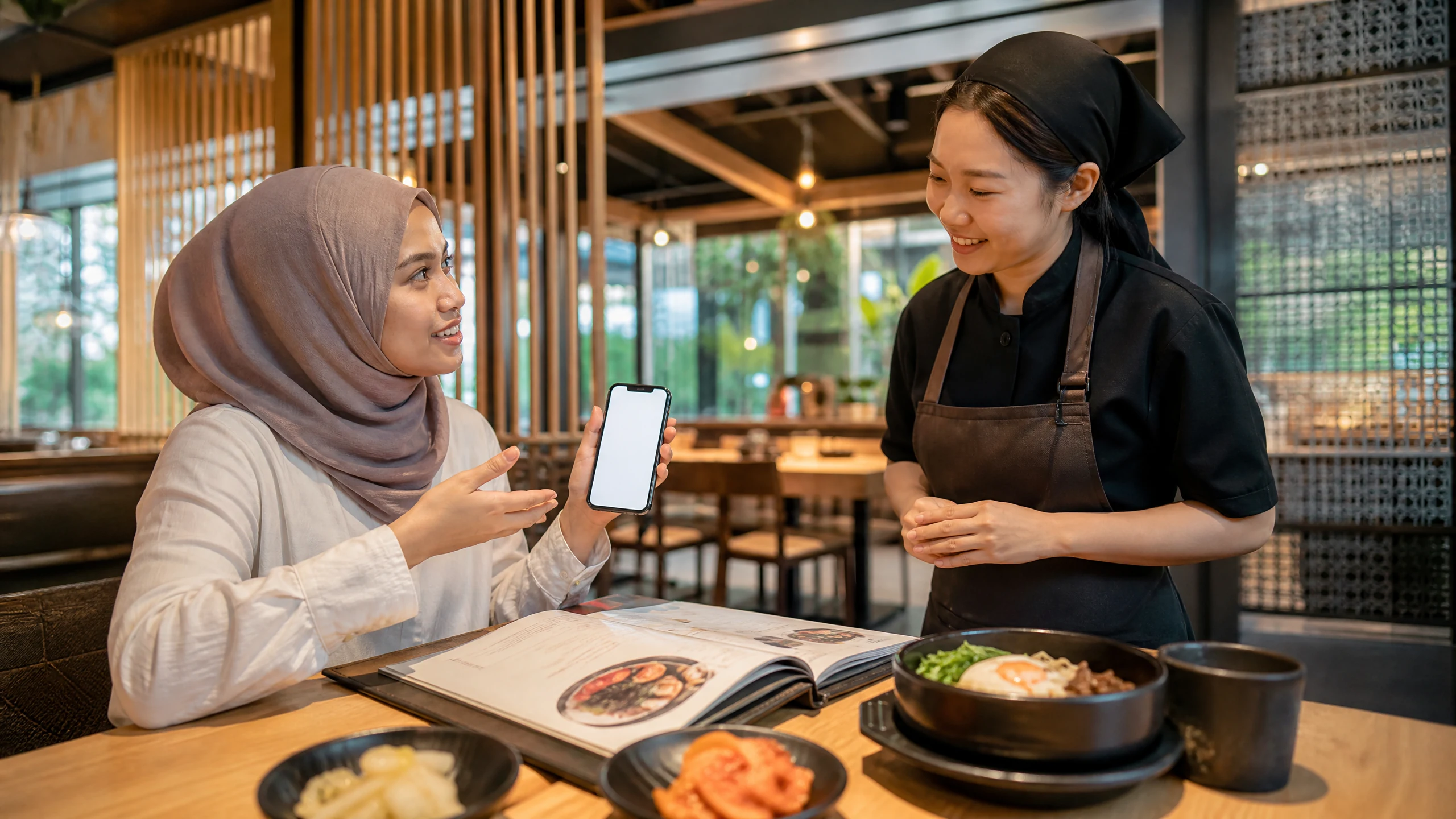
The pronunciation is only a travel aid. Showing the written Korean sentence on your phone may be clearer, especially in a busy restaurant.
How to use the KTO category and pictogram together
Start with the category, then look for the detail that affects your decision. For example, a halal-menu pictogram may tell you that a suitable menu exists, while a reservation-required pictogram tells you to contact the restaurant before arriving. An alcohol-free pictogram may matter if you prefer a fully alcohol-free environment.
I would also check the date of the restaurant information, opening hours, location, and current menu before traveling across Seoul or another city. Restaurant ownership and menus can change, and an official tourism listing is not a guarantee that every operating detail remains unchanged.
A simple decision path for your Korea trip
If you require formal certification, begin with the Halal Certified category and confirm the current certificate directly. If you are comfortable with Muslim-owned self-certification, review Self-certified restaurants and ask which dishes are covered. If you are considering Muslim Friendly or Pork free, treat the label as a starting point and verify meat, alcohol, sauces, broth, and preparation.
This is more reliable than looking for one universal list of “safe Korean food.” It respects different personal standards while giving you a practical way to decide when you are standing in front of a menu.
Reference
1 Korea Tourism Organization — Muslim-friendly Travel.
Explore Korea by topic
Choose a focused next step for Korea travel, halal food, prayer planning, or transport.
Explore more published guides
Keep planning with more published Muslim travel guides. New cards appear as you reach the end, or choose to load the next set.
 Halal talkMMA2 Lagos Airport Mosque & Chapel (LOS): Passenger GuideMMA2 lists a chapel and mosque on the terminal premises. Ask terminal staff for the current location and…Open guide
  Halal talkElazığ Airport Prayer Room (EZS): Official Mescit, Parking & Access GuideElazığ Airport (EZS) officially lists a mescit in its domestic terminal. The airport operator confirms parking is available…Open guide
  Halal talkFreetown Airport Prayer Rooms (FNA): First Floor GuideFreetown Airport has dedicated Christian and Muslim prayer facilities on the first floor, accessible to all passengers and…Open guide
 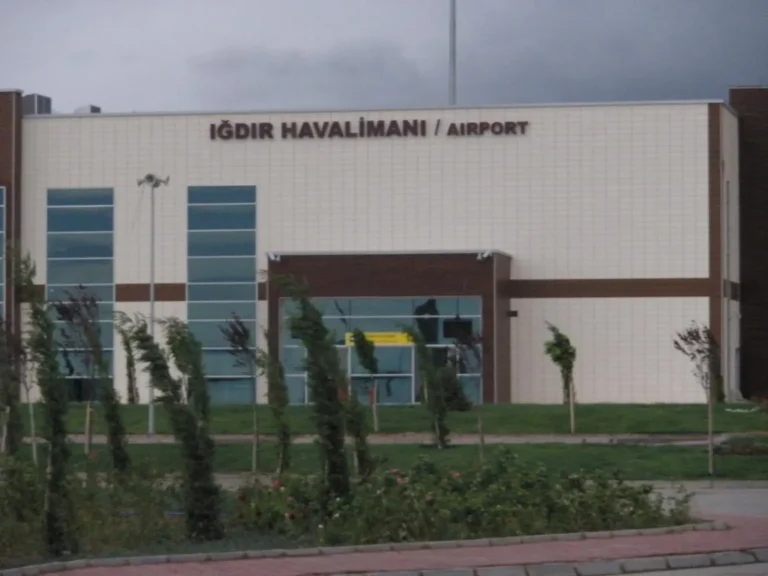 Halal talkIğdır Airport Prayer Rooms (IGD): 2 Mescits, Parking & Terminal GuideIğdır Şehit Bülent Aydın Airport (IGD) officially lists two prayer rooms in its one-storey domestic terminal. The airport…Open guide
 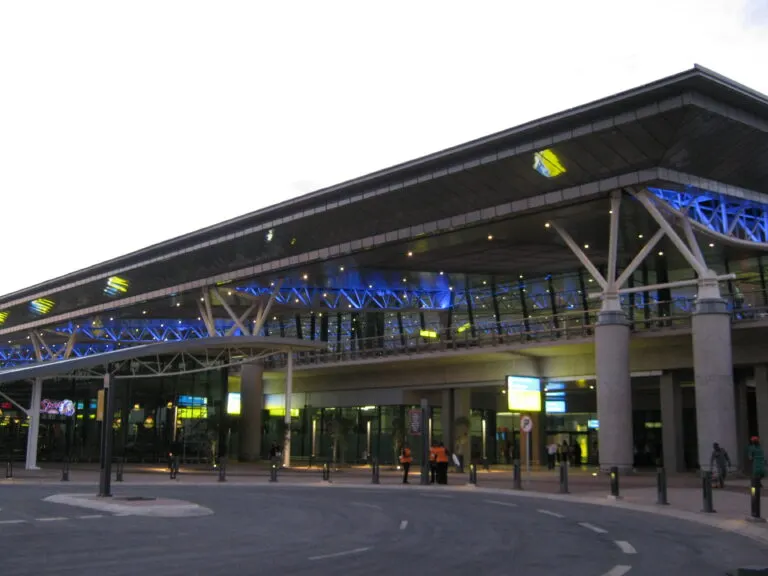 Halal talkKing Shaka Airport Prayer Rooms (DUR): Access GuideKing Shaka Airport has multi-faith prayer rooms for passengers. Ask an airport information desk for the current prayer-room…Open guide
 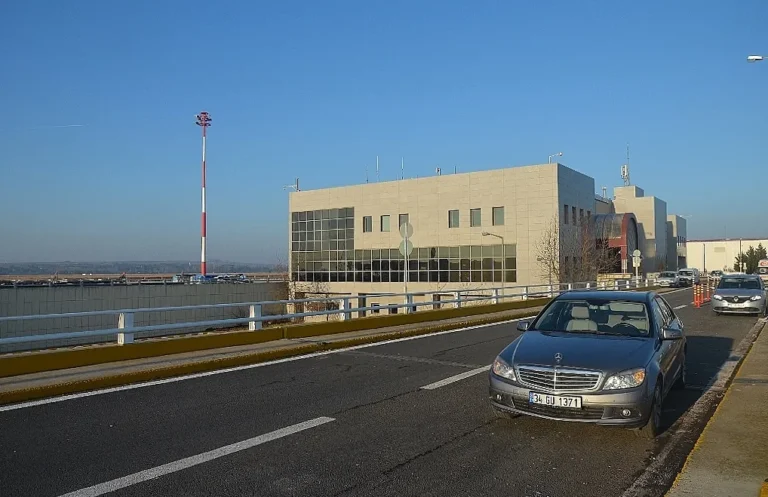 Halal talkÇorlu Atatürk Airport Prayer Rooms (TEQ): Terminal Mescit, Parking & Access GuideTekirdağ Çorlu Atatürk Airport (TEQ) officially confirms that separate women’s and men’s prayer rooms are inside its terminal…Open guide
 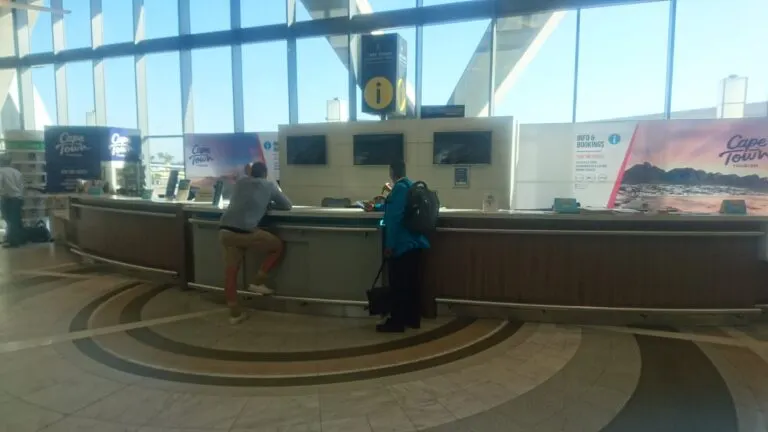 Halal talkCape Town Airport Prayer Room (CPT): Request Access GuideCape Town Airport can accommodate prayer-space requests. Ask any ACSA representative for the current prayer-room location and access…Open guide
  Halal talkKars Harakani Airport Prayer Rooms (KSY): 5 Mescits, Parking & Terminal GuideKars Harakani Airport (KSY) officially lists five prayer rooms: three for men and two for women. Domestic and…Open guide
  Halal talkOR Tambo Muslim Prayer Facility (JNB): 24/7 GuideOR Tambo Muslim prayer facility is open 24/7 in the basement parkade closest to Terminal A arrivals, with…Open guide